Tiki 38 Balanced Rigid Solar Panel Sail
concept for an array of solar panels with 2 degrees of freedom, which doubles as an airfoil for sailing
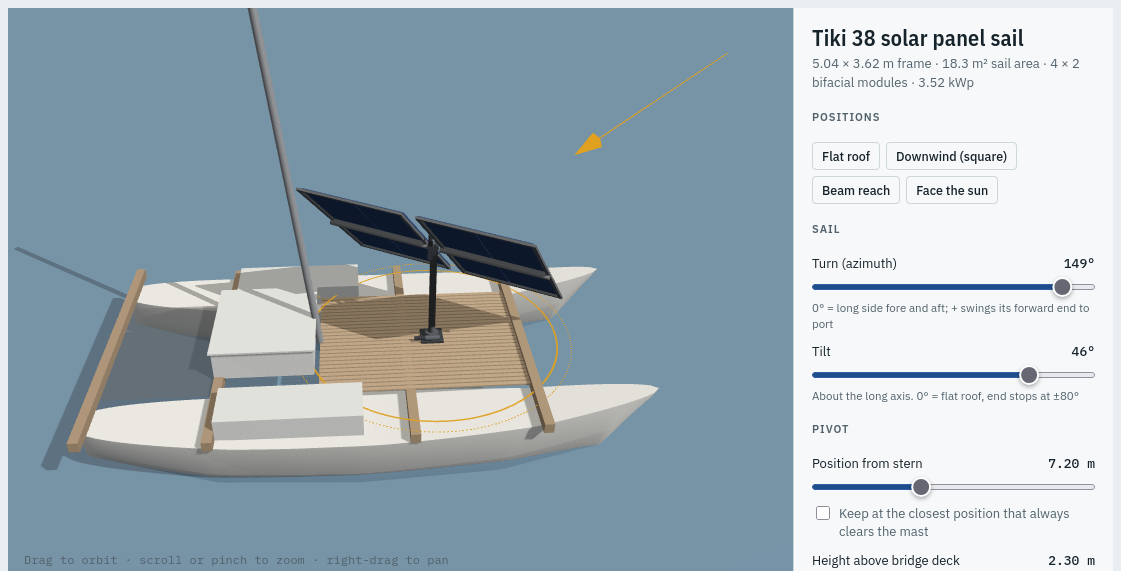
My Tiki 38 lost her fore mast. Instead of restoring it, I scale up the existing solar-electric propulsion system and replace the fore mast with an array of bifacial solar panels on a balanced pivot with two degrees of freedom (tilt and turn). At anchor and in light wind it is a flat roof over the bridge deck, or trimmed for solar harvest. On a reach or downwind it becomes a rigid sail, trimmed for propulsion. It can only be optimized for propulsion or for solar harvest at any time. Bifacial panels will always harvest at least some solar power in sailing mode.
status: concept, modelled in the 3D viewer; key numbers are in the factsheet
Market research
Initial research showed a few examples of rigid sails. These are mostly found on larger ships, where they add to propulsion and reduce fuel consumption, but do not serve as the exclusive propulsion:
- JAMDA (Japan Marine Machinery Development Association) fitted the tanker Shin Aitoku Maru (1980) with two rectangular rigid sails of 8 × 12 m, set by computer. Over her lifetime they saved about 10–30 % fuel. This is the closest precedent for a rectangular rigid sail.
- Eco Marine Power (Japan) builds the EnergySail, a rigid sail for ships with solar panels built in, part of its Aquarius MRE system of rigid sails, solar power and batteries. It has been through sea trials and holds a class approval in principle.
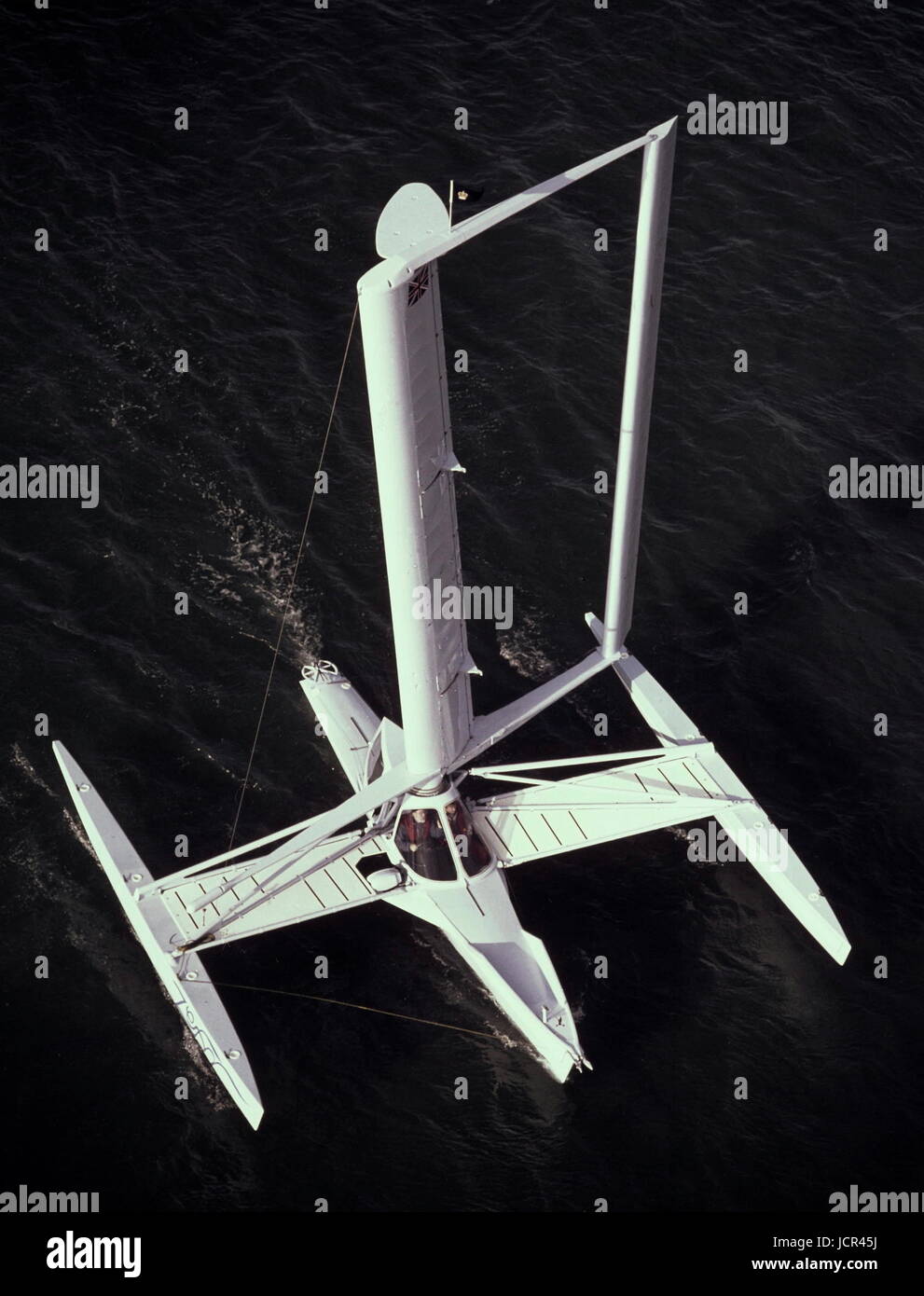
Also some concepts of rigid airfoils (Walker Wingsail) on smaller multihull yachts or unmanned boats:
- https://www.change-climate.com/Transport_Land_Sea_Sustainable/Assisted_Ships_Sails_Solar_Projects_Marine_Pollution/Walker_WingSails.htm
- https://www.alamy.com/stock-photo/walker-wingsail.html?sortBy=relevant
The closest relatives of a combined solar panel wing all go back to one inventor, Robert Dane (Sydney):
-
His patent for “A pivoting sailing rig” (priority 1996): wings with solar collectors that pivot between an upright sailing position and a flat, reefed position, on a catamaran. https://patents.google.com/patent/EP0935554B1
-
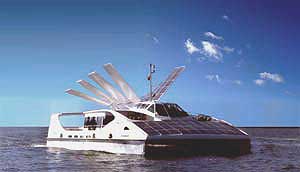
Solar Sailor, the company built on that patent: the ferry Solar Sailor went into service on Sydney Harbour in 2000, driven by sun and wind with pivoting “solar wings”, and four hybrid ferries followed for Hong Kong. The wings had to be stowed in winds over 40 kn. A later review noted that the wings could only harvest one source effectively at a time, which is also the premise of this concept.
- https://solarnavigator.net/solar_sailor.htm
- https://faircompanies.com/videos/solar-sailor-a-hybrid-ferry-with-solar-wings/
-
Ocius Technology, Dane’s later company: its Bluebottle unmanned surface vessel carries a rigid sail covered in solar cells. The sail folds flat onto the deck above Beaufort 5, where it keeps harvesting sun.
A patent for a “Dual-axis Solar Tracker”: https://image-ppubs.uspto.gov/dirsearch-public/print/downloadPdf/8237098 – not practical on the Tiki due to the huge circular base.
Solution design for the Tiki 38
The natural configuration for the solar panel array is a roof-like structure fore of the aft mast, covering much of the bridge deck area between the hulls.
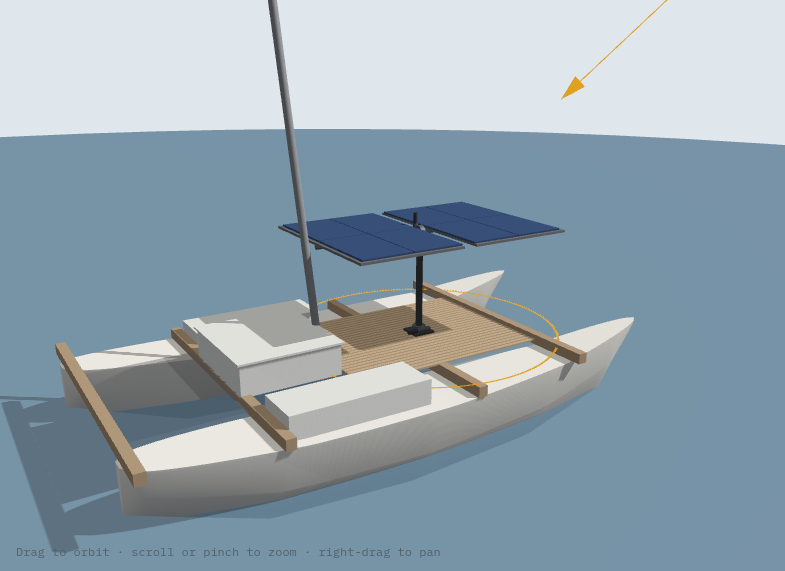
This configuration doubles as a sun roof.
From an aerodynamic perspective, it has the smallest possible profile area in laminar (horizontal) flow, which is important in strong wind. That makes it the lowest-drag position, but not a load-free one: gusts, pitching and rolling keep changing the angle of attack, and even a small angle makes a flat plate of this size generate large lift forces. In strong wind the array is therefore secured with stays at its corners, and in a storm the panels can be removed from their frame.
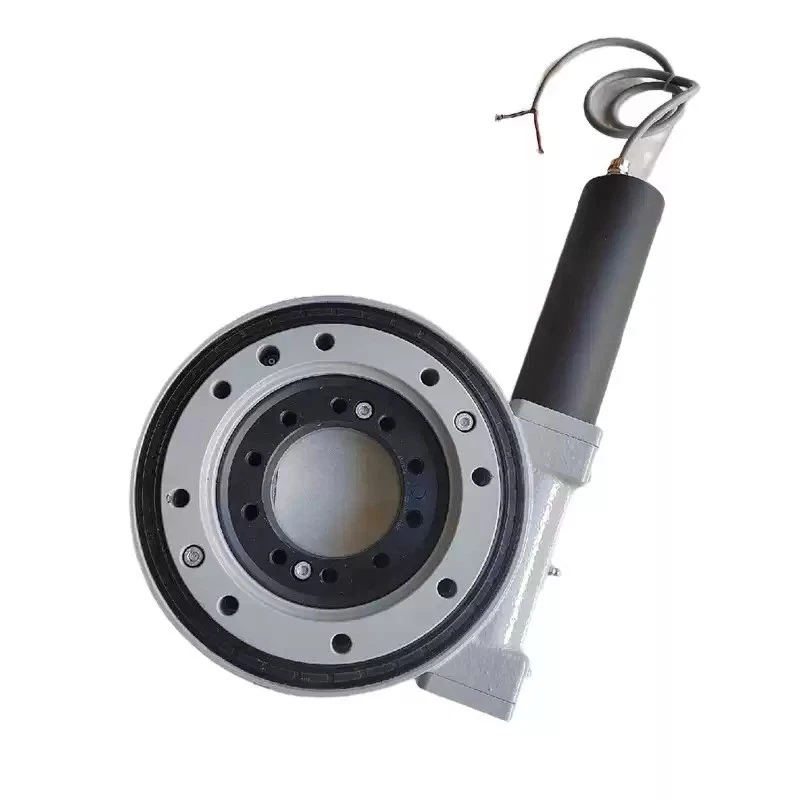
2 degrees of freedom (DOF) can be achieved with self-locking worm slewing drives (SE7/SE9 class, as used in dual-axis solar trackers), one per axis, like this one:
https://www.ebay.com/itm/357602390586
“Balanced” means the pivot sits in the middle of the array, so trimming does not have to lift its weight. It does not mean that the wind forces cancel out: while the array works as a wing, the centre of pressure lies about 25–35 % of its width behind the leading edge, not in the middle. The wind therefore always twists the array, and the drives have to hold it. Self-locking worm drives do this without power.
Using the 2 DOF, the solar panels can be oriented to maximize solar energy collection, and more importantly to adjust the angle of attack for sailing:
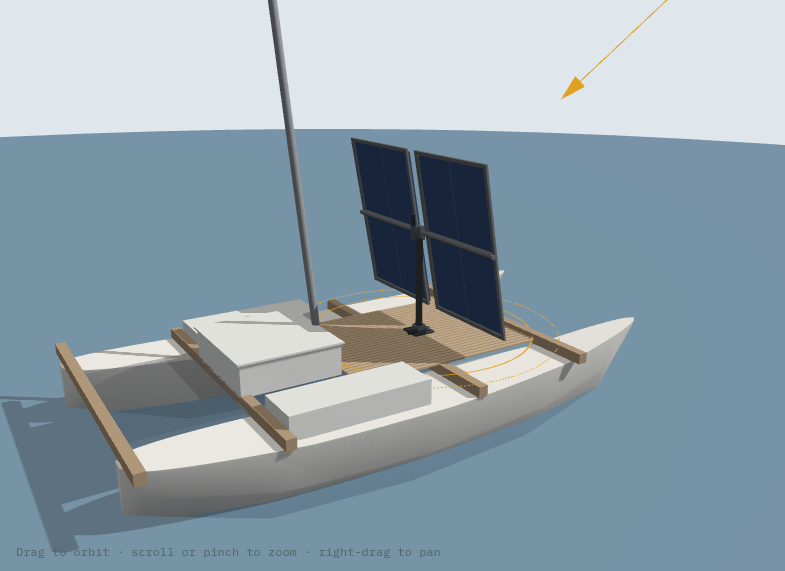 above: downwind configuration
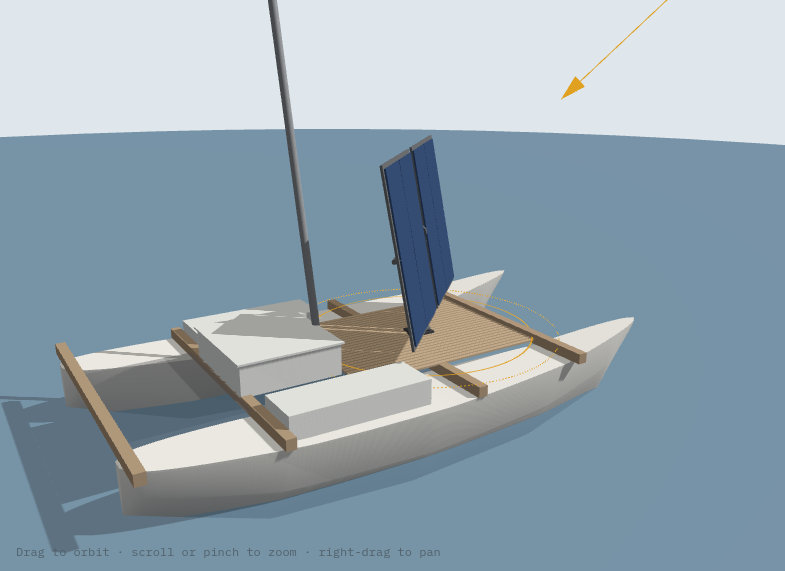 above: beam reach configuration
The main purpose of the sail is to restore upwind capability. Since the fore mast broke, only the aft sail is left, and on its own it cannot take the boat upwind: its centre of effort lies aft of the hulls’ lateral resistance, so the boat just turns into the wind. The solar sail replaces the missing fore rig.
This sets the key requirement: together with the aft sail, the solar sail must balance the combined centre of effort over the hulls’ lateral resistance. Its own centre of effort therefore has to lie well forward of the lateral resistance, as far forward as the aft sail lies behind it, and trimming either sail adjusts the balance.
Upwind, the solar sail mainly provides that balancing side force forward, so that the aft sail can drive. It also adds thrust of its own: a flat plate is a poor wing (lift-to-drag ratio of about 3–5), but it still drives as long as the apparent wind comes from more than about 12–15° off the bow. Pointing will be worse than with the original rig, and motor-sailing helps a lot, because the motor moves the apparent wind forward, where even a modest wing contributes.
On reaches and downwind, the solar sail is a strong driver on its own. As a rough order of magnitude, 18 m² give about 1 kN of thrust at 15 kn apparent wind, which is about 2.5 kW of propulsion power at 5 kn boat speed. For downwind sailing only, a spinnaker and a fixed solar roof would be simpler; the two degrees of freedom are what upwind sailing costs.
The two axes map onto the familiar controls of a sail: turning is the sheet, setting the angle of attack, and tilting is the reef. Upright is full power, the roof is fully depowered, and anything in between is a continuous reef that keeps the full area. In strong but manageable wind the sail is therefore leaned partly towards the roof instead of being set upright. On a catamaran, which heels about its lee hull, the lean goes to leeward when sailing upwind or reaching: the sail’s force then points down as well as sideways, which reduces the heeling moment and keeps the foundation in compression. Downwind, the lean goes the other way, so that the force points forward and up and lifts the bows, much like a wing in wing foiling. Every tack passes through the roof anyway, the fully reefed state.
Design details
Open points and design decisions are collected and numbered on their own page: Design Details.